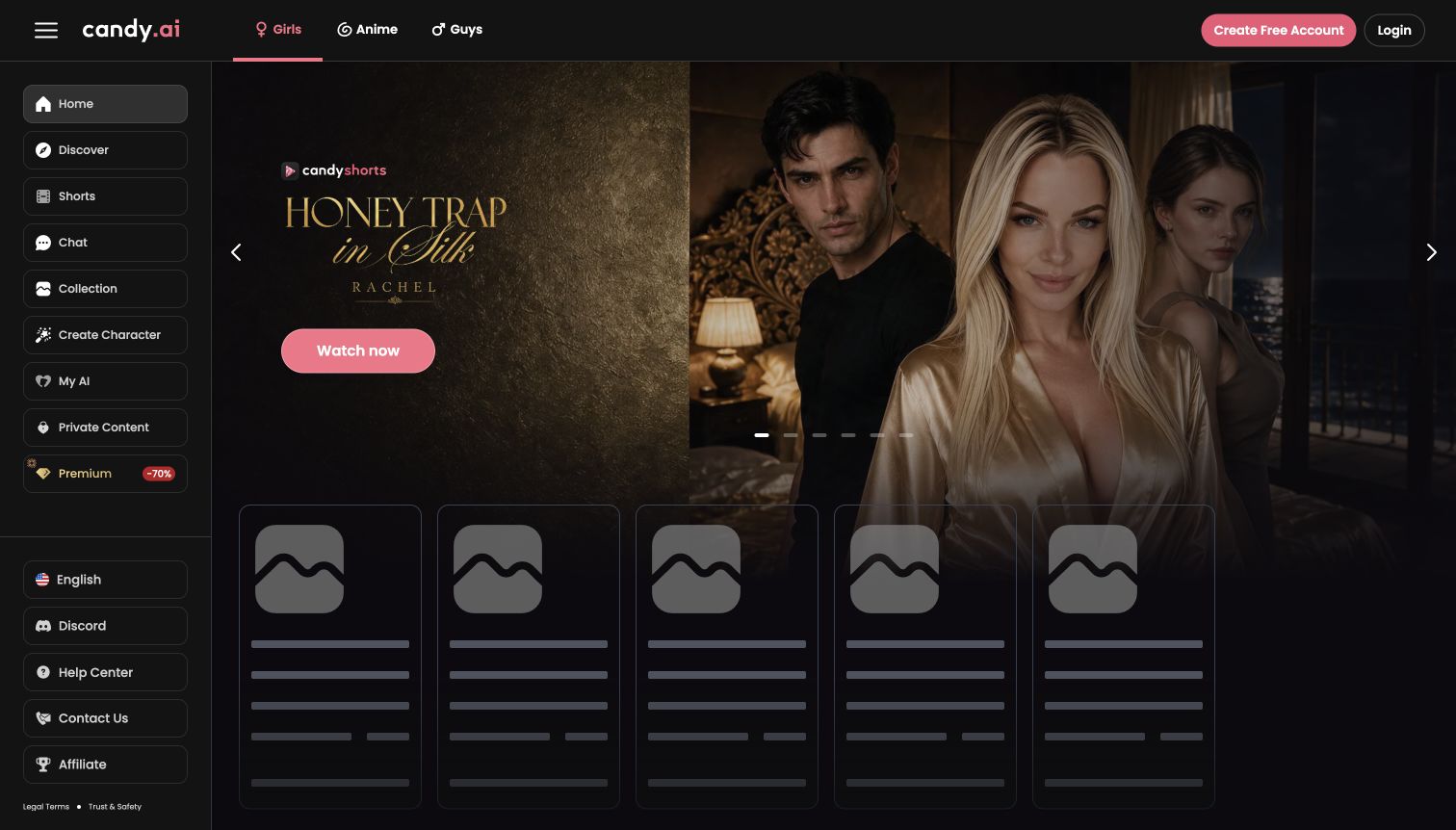
This is an asymmetric comparison. Candy provides a broad public proposition; Lovescape asks the account experience to supply most of the missing evidence.
Reader note
Bond Circuit may earn a commission if you buy through our links. It does not affect the price
you pay.
Retained from the balanced 1,000-query screen because this product pair had measurable comparison demand.
Bond Circuit verdict
Candy.ai is the responsible default because buyers can inspect more of its modes, pricing context and evidence before commitment. Choose Lovescape only if its relationship-led presentation creates a specific preference and the live account can answer price, feature, privacy and exit questions without requiring a long subscription.
Evidence-led default
Candy.ai
Broad public feature record
Dated consumer prices
Clearer pre-signup evaluation
Candy is easier to inspect, but no private quality or long-term continuity result was established.
A blank or unknown claim is not treated as a lost feature. It means the public evidence
did not settle it.
Candy.ai and Lovescape, based on dated public evidence.
Decision signal
Candy.ai
Lovescape
Buying consequence
Evidence depth
Broad public surface
Limited public surface
Candy requires fewer unsupported assumptions.
Companion chat
Publicly stated
Relationship positioning observed
Neither received a private conversation test.
Memory
Publicly stated
Not settled
Memory-first readers should not choose Lovescape on tone alone.
Images and video
Both publicly stated
Not settled
Candy gives visual buyers a clearer paper starting point.
Voice
Publicly stated
Not settled
Candy is easier to shortlist for voice, subject to mode verification.
Visible price
Dated prices retained
No exact logged-out price settled
Lovescape adds checkout discovery risk.
Privacy evidence
Public privacy claim
Insufficient public detail retained
Inspect both policies before intimate use.
Direct test
Not performed
Not performed
The verdict concerns decision quality, not claimed experience.
01
Candy wins the information contest before either app wins the relationship
Candy.ai gives an undecided buyer more to work with. Bond Circuit retained public claims for text chat, images, video, voice, customization, memory, free access and privacy, plus dated consumer prices. Lovescape presented a relationship-led product but did not expose enough stable detail for the same normalization. That gap does not prove Lovescape is weak. It means the buyer has to discover more after entering.
In a sensitive category, information cost matters. A reader should not have to create an intimate profile or supply payment details merely to learn whether memory, voice, media limits or account deletion exist. Candy is therefore the default, while Lovescape remains a conditional sample. The condition is strict: its free or smallest route must answer the buyer's deciding question without turning curiosity into a long commitment.
02
A fair comparison can have an uneven evidence column
Many affiliate comparisons repair sparse evidence by copying claims from old articles, snippets or adjacent brands. That produces a tidy table and a dishonest result. Bond Circuit leaves Lovescape cells unresolved where the retained official surface did not establish them. Unknown means exactly that. It does not mean no, and it does not earn a point for a plausible feature.
The asymmetry itself becomes useful advice. Candy lets the reader formulate tests before signup. Lovescape requires an evidence-collection session first: locate the plan, list the included modes, open the privacy and terms pages, find cancellation and identify the operator. If that basic map cannot be built quickly, the product has not earned deeper personal use. The full Lovescape review explains the public evidence gap without pretending to have used a private account.
Compare the live offers
Keep both product pages open while you read.
Check the current price, renewal and visible feature limits before choosing.
Lovescape's name and presentation suggest an ongoing romantic or relationship experience. That framing may be exactly what attracts a buyer, but it cannot establish continuity by itself. A companion feels consistent when character traits survive disagreement, earlier details return accurately and the system handles corrections without quietly rewriting history. Those behaviors require testing.
Candy at least makes a public memory claim, but Bond Circuit did not verify it across days. Give both products the same fictional preference and one corrected detail. Return after unrelated conversation. If Lovescape cannot expose a memory control or accurately retrieve the fact, its romantic framing should not rescue the result. If Candy recalls only after the prompt repeats the answer, its public claim has not passed either.
04
The first charming exchange is the least useful test
Landing pages and first chats are optimized to create momentum. The more revealing moment comes after the user disagrees, changes pace or asks the character to retain a boundary. Candy and Lovescape should receive the same ordinary scenario: a mundane plan, one emotional shift and a correction. Record initiative, repetition and whether the character keeps its defined tone rather than grading flirtation.
Avoid real names, addresses or vulnerable disclosures during this test. The buyer is evaluating a product, not establishing trust with a person. If either system pressures for more context while policy and deletion remain unclear, leave. Readers primarily interested in character control should compare the products listed in the roleplay guide rather than expecting romance branding to answer that need.
05
Candy has the visible media advantage, with quality still open
Candy publicly states image creation, video creation and voice. Those modes were not settled for Lovescape from the retained public page. Candy therefore has the stronger paper case for a buyer who wants the companion to extend beyond text. The limit is important: feature presence says nothing about prompt obedience, character consistency, voice latency or the number of paid attempts required.
If Lovescape reveals comparable modes after signup, run one matched image prompt and one short voice action. Check the meter before pressing generate. Count failures and revisions. A product that hides unit cost until after creation is harder to budget even when the result looks good. The visual guide gives specialist alternatives if media matters more than the relationship wrapper.
06
Candy supplies a number; Lovescape supplies a question
Candy showed $13.99 for one month and lower monthly equivalents on three-month and twelve-month selections on 14 August 2026. The immediate longer-plan totals and renewal details still require checkout confirmation. Lovescape did not provide a dependable exact logged-out price in our observation. Search-demand data shows that people ask about Lovescape cost and pricing, but demand cannot fill the missing number.
Open Lovescape only long enough to capture the current amount due today, billing period, next renewal, included messages or credits and cancellation route. Compare that contract with Candy monthly, not with Candy's lowest annual equivalent. If Lovescape requires annual payment before the product can answer a basic quality question, the uncertainty premium is too high. Use the pricing checklist before accepting any countdown discount.
Check the decision so far
Now compare the details against today’s offers.
Look for any price, policy or feature change that alters the verdict.
Sparse public detail makes the exit test more important
Companion products can accumulate conversations and generated media that users would not place in an ordinary social profile. Candy exposes privacy language, but Bond Circuit did not verify retention or deletion completion. Lovescape's thinner public evidence makes it even more important to locate the policy owner and account exit before sharing sensitive material.
Find the data categories, training-use wording, retention period, export options, deletion procedure and support route. Cancellation only stops future billing; it may not delete chat or media. Test with a separate email and fictional context. If the product cannot explain what happens after deletion, behave as if the data may persist. The privacy checklist turns that caution into a short inspection.
08
Lovescape needs a positive reason, not merely curiosity
Candy fits the person comparing the category itself. It provides enough visible breadth to ask whether chat, memory, voice or visuals will create lasting value. Lovescape fits a narrower reader: someone whose preference is already tied to its relationship presentation and who is willing to conduct an evidence audit inside the free surface. That is a legitimate reason to sample, but it is not a reason to prepay.
If Lovescape reveals a clear current price, appropriate controls and a character experience the reader prefers, it can win despite the public gap. The comparison is not designed to make that impossible. It is designed to stop unknowns being converted into imaginary parity. The burden moves to the live product, where the buyer can collect facts and leave without rewarding ambiguity.
09
Skip both if you want evidence before account creation
Candy is better documented, but important private outcomes remain untested. Lovescape requires even more discovery. A reader who wants audited long-term memory, independently measured privacy or verified cancellation should choose neither based on this page. Those results do not exist in the retained evidence.
Also skip both if the actual need is a boyfriend-first product, a narrow visual generator or a known price ceiling. Use the boyfriend shortlist, the category cost comparison or the overall guide. A comparison page should reduce the field, not trap the reader inside two familiar names.
Lovescape should not win merely because its unknowns leave room for an ideal product. Missing price, media and policy detail must be resolved by the live surface. Write each answer down before the sample. If the account does not reveal it, preserve the field as unknown instead of interpreting the interface optimistically.
Candy should not win merely because it supplies more labels. Run one ordinary chat after the setup excitement fades, one correction and one relevant media action. The broader stack earns its advantage only when those modes work together and the current meter remains understandable.
The safest tie-breaker is reversibility. Prefer the candidate that lets the buyer test the deciding behavior on a short contract, understand the next charge and leave without moving private history. When neither does, a third product is a better comparison than a forced winner.
Choose by circumstance
The winner changes with the job.
These scenarios turn feature claims into a smaller, testable decision.
Candy.ai
You want the most inspectable first choice
Candy gives the buyer more public feature and price context before registration.
Lovescape
Lovescape's relationship style is the attraction
Run a cautious free or short sample, but verify the contract and exit before supplying personal context.
Candy.ai
You need voice or video
Candy publicly states both. Confirm the exact mode, allowance and unit cost before paying.
Keep looking
You require proven durable memory
Candy states memory and Lovescape remains unresolved, but neither received a multi-day test.
Candy.ai
You refuse hidden pricing
Candy has dated visible prices. Lovescape must first reproduce a clear current checkout.
Keep looking
You want independent privacy assurance
Bond Circuit did not conduct a security audit or verify completed deletion for either product.
Seven-step buyer test
An evidence-first Candy and Lovescape trial
Spend the first session collecting facts, not building attachment. Lovescape has more unknowns to clear, so it should receive no larger initial commitment.
Step 01
Map the live offer
Record each product's current price, billing period, included modes, limits, renewal and cancellation route.
Step 02
Locate policy and deletion
Find the operator, data-use terms, retention language and exact account-deletion path before sending personal material.
Step 03
Create matched fictional profiles
Use the same adult character brief, relationship frame, two traits and one boundary in both apps.
Step 04
Test an ordinary conversation
Discuss a mundane plan, disagree once and correct one fact. Record repetition, initiative and persona drift.
Step 05
Test recall later
Return after another topic and ask an open question about a planted fictional preference.
Step 06
Test one paid mode at most
If images, video or voice matters, confirm the meter and run the same constrained action in each product.
Step 07
Leave ambiguity unpaid
Choose only if the preferred product answered the deciding question and exposed a clear exit. Otherwise cancel both.
The controlled next step
Use the smaller commitment that can answer your question.
Open the current plan and policy pages first. If the amount, renewal, deletion route or
feature limit changes, trust the checkout and current policy over this dated comparison.
Candy.ai is the better-documented choice in Bond Circuit's current evidence. It exposes more features and dated price context. We did not run private accounts, so that is not a claim that Candy has better conversation quality.
What does Lovescape offer?
Lovescape presents a relationship-led companion proposition, but our retained public-page review did not settle a dependable feature, pricing and policy record comparable with Candy. Check the live account before assuming specific modes.
Which app has better memory?
Candy publicly states memory. Lovescape memory was not settled in our public audit. Bond Circuit did not test either product across days, so no memory-quality winner can be named.
Is Lovescape cheaper than Candy AI?
No responsible comparison is possible from the retained evidence because Lovescape did not show a settled exact logged-out price. Candy displayed dated prices, but its current checkout must still confirm the immediate total and renewal.
Which is better for voice and images?
Candy publicly states voice, images and video, giving it the clearer paper position. Bond Circuit did not grade those outputs. Lovescape may expose modes after signup, but that must be verified rather than assumed.
Why publish a comparison when Lovescape evidence is limited?
Measured search demand shows that buyers ask this question. The page answers honestly by explaining the asymmetry, naming the unknowns and giving a safe trial protocol instead of fabricating feature parity.
How this comparison was made
This page uses the dated official observations, public claim ledger, Candy.ai review and Lovescape review. A blank Lovescape field remains unknown and is never treated as a missing feature.
Bond Circuit did not buy either plan, chat privately, generate paid media, test deletion or collect a representative user sample. Search volume justified a distinct decision page but did not influence the product verdict.